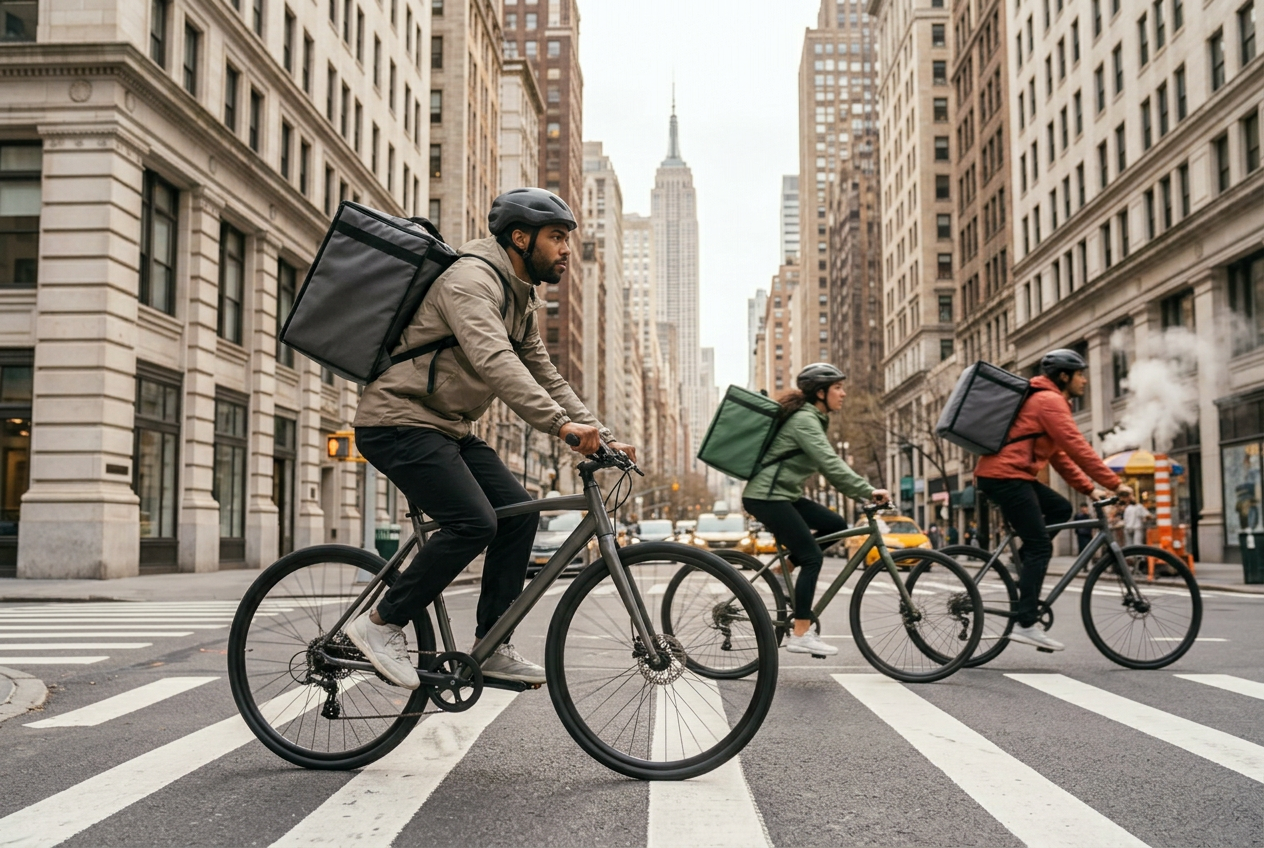
Delivery in the United States stopped being a separate service and became practically a layer of the economy.
Food delivery alone moved around $353 billion in 2025, with the global market passing $1.4 trillion and projected to reach more than $2 trillion by 2030. Three companies dominate almost everything: DoorDash leads with 56% of the market, followed by Uber Eats at 23% and Grubhub at 16%. And the habit has taken real root — 62% of app users pay for a premium subscription, which means delivery is no longer the exception; it's a fixed monthly line in the budget.
And it's not just prepared food. Grocery has migrated to the same logic: online grocery sales grew more than 20% a year for six consecutive quarters through early 2026, and today represent more than 19% of all grocery sales in the country — a strong jump from under 15% just over a year ago. A chain like Walmart is already approaching 40% share of that market, betting heavily on one-hour delivery, while Amazon expanded so much it now offers fresh grocery delivery in as little as 30 minutes. In other words: it became a dispute over minutes, not days.
But why does this market grow so much, and why do we buy into the idea so easily? A study published in the International Journal of Contemporary Hospitality Management went after exactly that answer: first with focus groups, then with a quantitative survey of 423 delivery app users, evaluating five types of value that weigh on the decision to order — price, food health and safety (what the researchers call functional value), the status of using a trendy app (social value), delivery fee and speed (conditional value) and the curiosity of seeing everyone around you using it and wanting to try it too (epistemic value). And the result is somewhat revealing: the factor that best explains adoption isn't price, or even pure convenience — it's precisely that epistemic value. In second place comes conditional value: cheaper delivery, faster shipping, promotions, restaurant variety — everything that reduces friction in a specific moment. Low price only shows up after that.
And that's where I was genuinely surprised: food safety, which belonged to that same group of factors, showed no statistically significant correlation with respondents' purchase intention — meaning that for a good share of the people surveyed, that risk simply doesn't weigh on the decision. For me, provenance is a real criterion when choosing where to order, especially here in NYC: if I don't know where the food comes from, I simply don't order — which, I admit, limits my options quite a bit. And that's exactly why this finding intrigued me: a criterion that enters my equation every single time, for most of the people surveyed, seems not to exist at all.
This helps explain how a consumer chooses one specific platform over another. An Intouch Insight study, which analyzed 600 orders split across the three big American players (200 per app), showed that DoorDash delivers in 26 minutes on average, against 38 minutes for Uber Eats — but Grubhub, even slower, meets its promised deadline in three out of four deliveries, which generates another kind of trust. Order accuracy weighs heavily: DoorDash gets 98% of orders right, against 88% for Uber Eats and 85% for Grubhub, and food at the right temperature plus a correct order show up as the factors that most determine whether a customer left satisfied — even more than the fee charged. And once someone picks an app, they tend to stay: in the same research, 31% of consumers said they're loyal to a single app, 50% usually always use the same one, and only 19% actually alternate between platforms comparing prices. In other words, the initial decision weighs far more than we imagine — after that, it becomes habit, not a rational choice recalculated every time.
And here's a comparison I think is worth making with Brazil. While the American market is disputed among three big players, in Brazil the concentration is on another level: iFood holds more than 80% of the food delivery market, processing over 100 million orders a month in more than 1,500 cities — a dominance so large that no other country in Latin America comes close to that concentration. Uber Eats, by the way, left Brazil in 2022, unable to compete. The Brazilian food delivery market moved around $6.7 billion in 2024, projected to reach $11.7 billion by 2030 — growing fast, but still a fraction of the American size. On the commission charged to restaurants, iFood charges between 12% (when the restaurant handles its own delivery) and 23% (when iFood handles delivery and payment), a range similar to the American one — in the US, DoorDash, Uber Eats and Grubhub charge between 15% and 30% per order — except it's concentrated in a single player. That gives iFood a negotiating power over the small restaurant that none of the three American companies has alone, since in the US they compete with each other for that restaurant.
And that's exactly where you can draw two lessons, one for each side. On the Brazilian side, what jumps out is the lack of real competition: in the United States, three companies fighting for the same restaurant and the same customer created a culture of public performance comparison — speed, order accuracy, on-time delivery, the same numbers I mentioned above — that becomes a marketing metric and constant pressure to improve. With iFood dominating more than 80% of the Brazilian market, that pressure simply doesn't exist in the same way.
On the American side, there are at least two things iFood does better. The first is reach: iFood covers more than 1,500 Brazilian cities, including small countryside towns no American app would ever target — DoorDash, Uber Eats and Grubhub concentrate almost their entire operation in dense metro areas and leave much of the country uncovered. The second is payment: Pix became part of everyday Brazilian delivery — instant transactions, available 24 hours, with no card network fee in the middle — which makes the operation cheaper for the app and the checkout faster for the customer. In the United States, there's still almost complete dependence on credit cards, with all the intermediation cost that carries. Beyond that, iFood also invests heavily in retention tools, like its own prepaid card and a benefits subscription club, designed to keep the customer without depending only on one-off promotions.
In the end, I think both markets do have something to learn from each other — in a very concrete way.
What the United States does better is exactly what can be measured: the competition among DoorDash, Uber Eats and Grubhub forces all three to compete publicly on speed, order accuracy and on-time delivery, because a dissatisfied customer has two other apps waiting. iFood, alone in more than 80% of its market, doesn't feel that same daily pressure. Brazil, with iFood, solved two things the United States still hasn't: reaching small towns no American app targets, and a way to pay that's faster and cheaper than any credit card. I keep thinking that the ideal delivery, if it existed, would pull the American culture of competition and the Brazilian reach and practicality.