This piece started because I still struggle to find a cup of coffee that matches my taste. Back in the day, whenever I went looking for a great brew, I'd end up disappointed — maybe because I ordered wrong? Could be... but was I really capable of ordering wrong every single time, in different places? Even a simple black coffee could be hit or miss.
These days I've swapped coffee for decaf and built my own coffee routine at home. You know that whole "romanticize your mornings" thing we see in every viral video online? At least I try.
But something has always intrigued me: how can it be so hard to find a cup that matches my taste when I live in Manhattan — a place that has, depending on which survey you believe, somewhere between 1,700 and over 4,000 coffee shops scattered across the city, a market worth billions of dollars a year in coffee alone, and where dozens of new coffee shops open every year. My block alone has 3 different ones. Until recently, it had 4.
Another thing that interests me is that some coffee shops get hyped — whether for the coffee itself or for the now-celebrated matcha. There are coffee shops with lines out the door just to get that elixir in hand. And I swear I'm not judging here — honestly, I find it fascinating, watching consumer behavior play out in real time around something that just doesn't hold the same appeal for me.
And I can't stop thinking about it: whenever I'm walking around and spot a place with a line out front, I always wonder — why that one, with that massive line, and not the empty coffee shop two doors down?
So I went and looked into it, because I needed to understand — and I landed on a pretty unromantic conclusion: a line, more often than not, isn't proof that the coffee is good. The line is the business strategy. In marketing, there's even a name for it: "scarcity theater" — visible demand becomes, in itself, the social proof of quality, without anyone actually having to prove anything. And the numbers back this up: a single viral TikTok trend can boost visits to a coffee shop by up to 120% in a single week, and 42% of consumers say they try a new place specifically after seeing a creator's content. There's a behavioral layer to it too: sharing the wait with strangers on the sidewalk has become, for a lot of people, a social experience in itself — almost a ritual of belonging in a city too big for any spontaneous intimacy. Standing in the right line says something about you: that you're in the know, that you know where to go, that you're willing to wait for it. A grocery store line, obviously, will never carry that same symbolic weight — except our beloved Trader Joe's, but that's a topic for another post.
Add to that the algorithm, which today functions as a genuine sales engine for the coffee retail business. We traded the award-winning barista and the food critic for the content creator we relate to — and that shift isn't just cultural, it's measurable: market research shows that 92% of consumers trust influencer recommendations more than traditional advertising, and 58% trust user-generated content more than any paid ad. That's exactly what happened with a hot chocolate that blew up overnight — I tried it myself, and it wasn't worth the hype; I've had better, right here in NYC. And again, this isn't a judgment, it's simply a fact about how purchasing decisions have changed: today we choose based on identification, on affinity, and the coffee market has learned to sell exactly that.
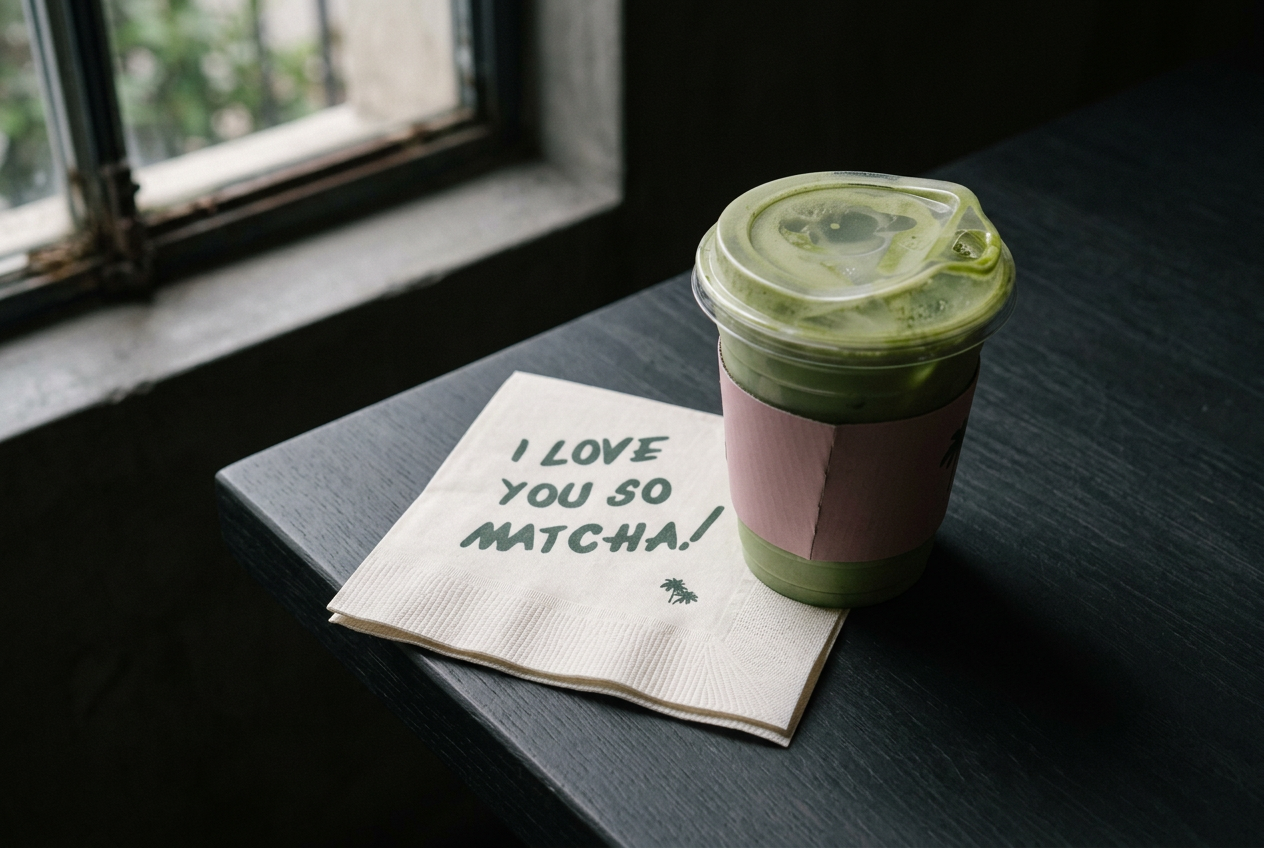
There's also a visible investment in aesthetics that is, in practice, a customer-acquisition strategy: an instantly recognizable cup color, a drink photographed like a product launch, a coffee shop designed with the feed in mind as much as the menu. Market studies show that coffee shops with a strong Instagram presence see up to 45% more foot traffic, and that 60% of Gen Z chooses where to get coffee based on how the photos look, not necessarily on taste. That helps explain a good chunk of the matcha boom: a market already worth more than $5 billion globally, growing at an estimated rate of 7% a year, built around a green, photogenic drink that's perfect for a fifteen-second video — aligned with a generation that, according to recent surveys, treats itself to something like this almost every week.
In the end, I think my struggle was never as personal as I thought. New York is full of people running around all day, with coffee shops functioning more as quick stops than places to sit and stay — and that creates a massive baseline demand that any well-positioned hype can capture and scale fast, even if there's better coffee two doors down, with no line at all, that no one will ever know exists.
Either way, next time I walk past a line of twenty people, I'm going in. Just to see what it's about. I'll let you know if it was worth it.