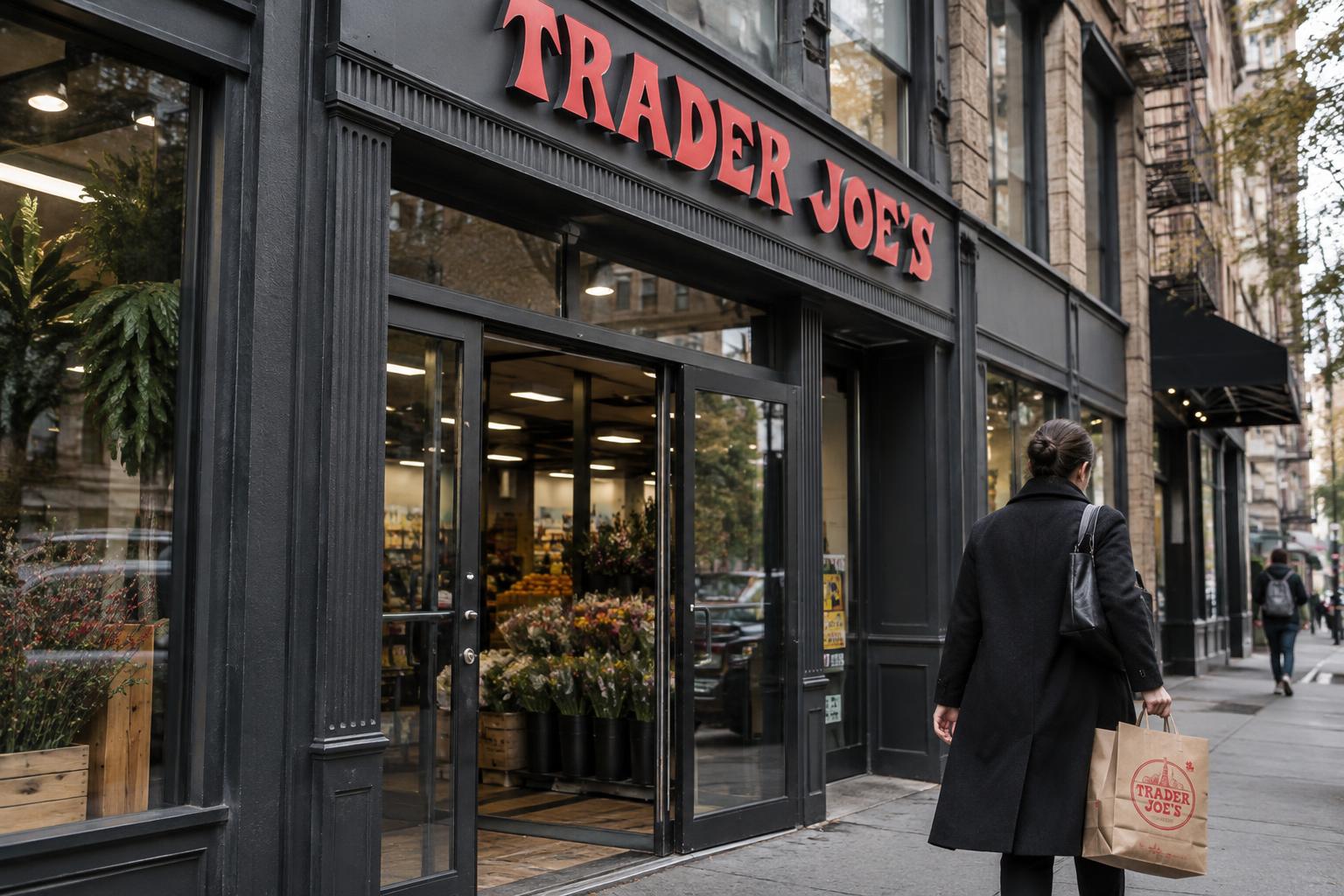
Trader Joe's is America's darling, and the right word here isn't craze, it's connection — the way people relate to this store. And of course, it has all of my heart.
Not that I'd stand in line for the most coveted tote bag in the country, the one that's basically the Hermès of grocery bags (yes, a line again — apparently around here it's always about that). But it is always my first option, and I catch myself thinking about their exclusive products with suspicious frequency.
I put that down to several things. The packaging is creative and genuinely lovely to look at. Most of what sits on the shelves is private label — and the number is striking: around 80% of the roughly 4,000 products they sell are Trader Joe's own, against an average of 15% to 20% in traditional supermarkets, which on top of that usually carry tens of thousands of items. It's far less choice, but far more curated choice — and apparently that's exactly what works.
One of the things I find most interesting is that they carry products from all over the world. I drink my Brazilian coconut water, bought off a shelf in Manhattan, and I think that's wonderful. There are the beloved brigadeiros, which caused a small stir a while back because they were sold as a "Portuguese sweet" (nothing against the Portuguese, but we know how deeply Brazilian our little brigadeiro is). There's simit, the Turkish bread, there are dumplings, a delicious Belgian chocolate, a spread from Italy, and so on.
And it's not just me: some people who travel to the United States make a point of stopping at Trader Joe's and going home with a suitcase full of hyped products to hand out in Brazil. That's not an exaggeration — travel research shows that 39% of travelers visit a grocery store during a trip, and 44% make a point of buying local products to bring home. There are extreme cases, like the "Everything But the Bagel" seasoning, which ended up in an airport warning in Incheon, South Korea, because poppy seeds are banned there — and people still try to sneak it in, that's how loved it is. And that tote bag I mentioned? A limited edition has been resold abroad for as much as $500.
Beyond the products, there's a unique atmosphere: the music is good and you find every kind of person working there — it's diversity working in practice, and it's beautiful to see. The company itself says this publicly: it keeps a dedicated diversity and inclusion leadership role and has handed out hundreds of scholarships to employees through internal programs. It isn't just store vibes, there's structure behind it. Financial structure too: a part-time store employee can earn up to $24 an hour, nearly double the federal minimum wage, with an automatic 10% retirement contribution and real health coverage. Founder Joe Coulombe used to say the big difference between Trader Joe's and its competitors was always the income level of its employees.
That isn't stray generosity, it's a model studied in management for decades: the service-profit chain, formulated by Harvard researchers Heskett, Sasser and Schlesinger, shows that a well-treated employee stays longer, serves better, creates a satisfied customer, who becomes a loyal customer, who generates profit — profit that funds the well-paid employee again. It's a cycle, not an expense. And maybe that's why you can feel the difference the moment you walk in.
I'd guess 10 out of 10 people in the United States set foot in that store at some point in the month — and maybe I'm not exaggerating that much: in the 2026 American customer satisfaction study, with around 31,000 people surveyed, Trader Joe's came first among grocery chains, passing Publix for the first time after years at the top. It's practical proof of that cycle: satisfied employee, satisfied customer, satisfied result.
I keep imagining the logistics of bringing all those own-brand products from different places, with different demands. From what I found, their strategy is precisely to skip the middleman — buying directly from local and international suppliers instead of outsourcing everything to large distributors, which also explains why the curation is so lean: fewer suppliers, fewer SKUs, more end-to-end control. And choosing fewer products rather than more has academic backing too: psychologist Barry Schwartz described it as the paradox of choice — the more options you offer, the heavier the mental load of deciding, and the greater the chance of regret afterwards. Trader Joe's clearly bets against the "more is better" logic that dominates traditional retail, and the result shows up at the register: their revenue per square foot is far above the industry average.
I imagine the revenue of the whole chain — and because the company is private, the numbers that circulate are estimates, but they hover between $13 and $20 billion a year, from just over 660 stores across 43 states plus the District of Columbia, with more than 50,000 employees. It's a giant scale for a company that, if you notice, works hard to feel small.
And you know what else: zero delivery. You have to go there to get your products. From what I read, that's a deliberate decision, not laziness: the idea is to protect the in-store "treasure hunt" — that discovery of a new item that only happens because you showed up in person — and to keep operating costs low, without the expensive machinery of delivery logistics. As a 42signals article on their retail model put it nicely: there, the "add to cart" button is literally your car key. In practice, that's what classic business strategy literature, starting with Michael Porter's work on competitive strategy, calls focus: instead of trying to be everything to everyone, the company deliberately chooses what it will not do — no delivery, no aggressive promotions, no product that doesn't clear their quality bar — so it can be excellent at one thing. Saying no with that kind of consistency is, honestly, rarer in management than any product innovation.
And there's another thing that catches my attention: Trader Joe's trends hard on social media without appearing to try. Take a look at their Instagram — it's worth seeing how their communication escapes the obvious grocery playbook: product photos shot like a fashion editorial, matching colors, deliberate styling, much closer to a lifestyle brand campaign than a supermarket flyer. And most interesting: a good share of that reach doesn't even come from the official account — it comes from fan pages, like the one with nearly a million followers dedicated purely to store finds. There are even fan accounts in countries with no physical store, like Indonesia. Imagine that. That's what marketing people call earned media: instead of paying to show up, the brand invests so much in product and experience that the customer becomes the promoter for free — which costs far less than any paid campaign, and convinces far more.
All of this leaves me with a question: do we have a "Trader Joe's" in Brazil? A brand that combines fair prices, curated products, a strong visual identity, well-treated employees and that almost irrational loyalty? Honestly, I can't think of one that comes close. Can you? Maybe the answer isn't copying Trader Joe's product by product, but copying the logic behind it: pay well, curate well, and have the courage to say no to everything else.